The Doorstop as a Wedge: Why a Small Taper Holds a Door
Doorstop wedge mechanics show how taper, contact and fit affect a door’s movement, helping you identify why a stop slips and choose a safer alternative.
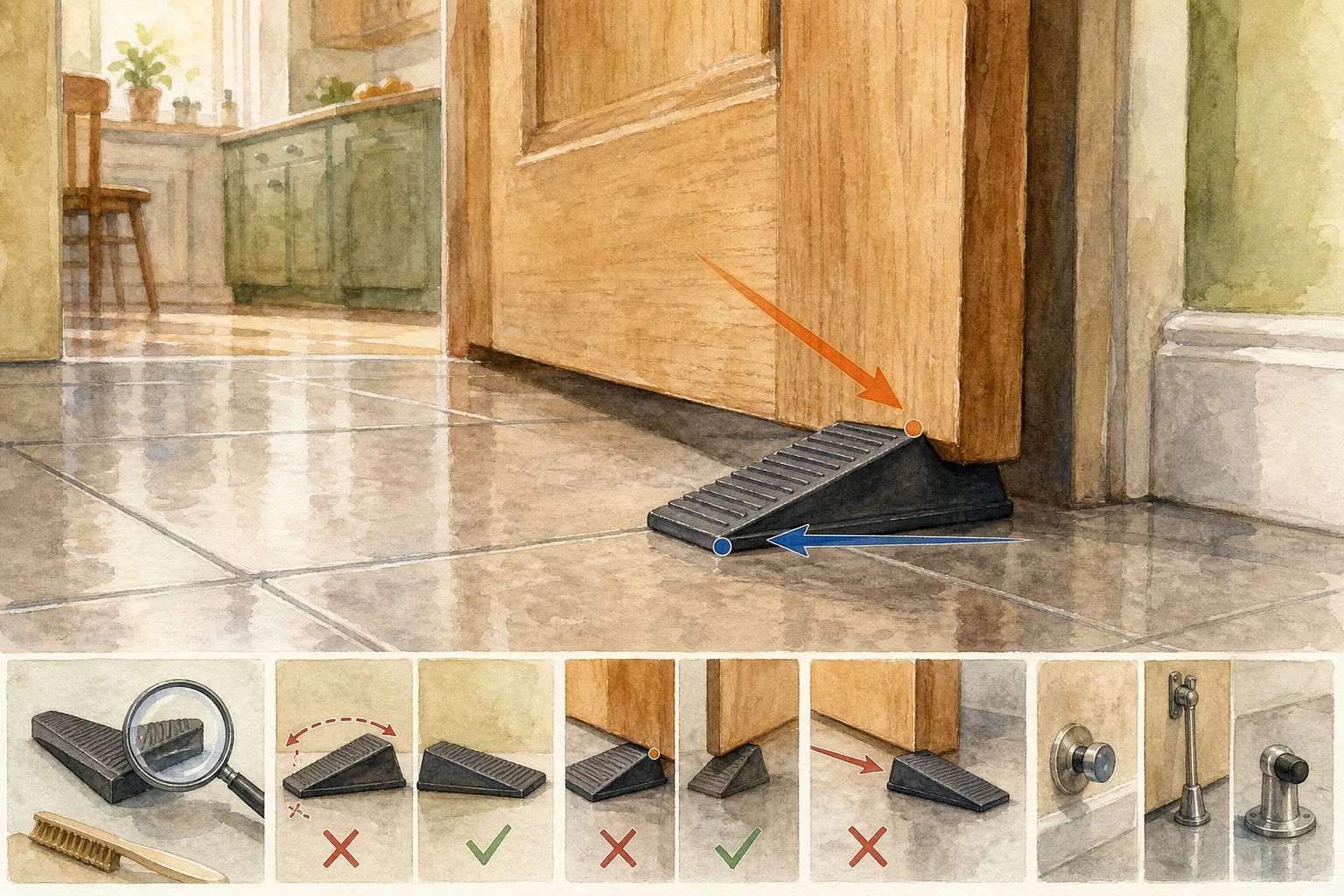
Doorstop wedge mechanics depend on more than the wedge’s slope: the door, the floor and the direction of the push all shape whether it stays put. A stop that creeps across tile may fit beneath the door yet still lack enough grip at its base.
The wedge redirects the door’s push through its sloping face. It is not a lock; its position relies on the way the door and floor press against it, much as a door held by a chair depends on the chair staying braced.
Force through the wedge
The thin end enters the gap beneath the door, while the thicker end remains outside. As the wedge slides in, its upper slope meets the door and its base meets the floor. Those two contacts resist movement in different ways.
The door presses down and along the slope, while the floor pushes back against the base. Friction at each surface can help keep the wedge seated, but a polished face or dusty floor may let one contact slide even when the other grips.
The wedge’s angle determines how it meets the door and how the push acts along its slope. A steep wedge is not automatically more secure: if it rocks, catches on a corner or needs force to insert, it may be unstable and awkward to remove.
Two surfaces, two jobs
Consider the base-to-floor contact separately from the slope-to-door contact. A rubber base may grip a hard floor while a slick upper face lets the door slide over it. A textured upper face may catch the door while a smooth plastic base moves across tile.
Dust, hair and polish residue can interfere with either contact. Clean the wedge and floor using methods suitable for their materials; avoid solvents or abrasive pads unless the maker says they are safe. Replace a cracked, hardened or badly worn stop rather than improvising a repair.
Fit matters as much as surface texture. The wedge should slide in without being forced, meet the door on its slope rather than a sharp corner, and rest flat. If it rocks or touches at an unstable point, choose a different shape or size.
Choosing a suitable stop
Rubber wedges often have a grippy base, while wooden models may suit some floors depending on their finish and the surface beneath them. A broad base can reduce rocking, and a softer face can cushion contact; neither feature makes up for poor fit or grit underfoot.
Place the wedge on the side towards which the door is moving, then slide it in gradually with your hands clear of the lower edge. It should meet the door without a hard kick. If the door pushes the stop towards its thin end, it may drive the wedge out instead of seating it.
Say you have a light internal door over smooth kitchen tile and a plastic wedge that keeps creeping forward. You clear visible grit, check that the wedge base remains smooth, and replace it with a rubber-bottomed stop that fits the gap without being jammed in. The expected observation is whether the base stays in place during ordinary door movement; if it still moves, the door’s push or the floor may not suit a loose wedge.
When does another holder suit better?
Why does a doorstop slide on tile?
A smooth base, dust or polish residue can reduce grip on polished tile. Clean both surfaces with a material-safe method; if the stop still slides, choose a compatible base or another holding method.
Does a steeper wedge hold better?
Not necessarily: angle, fit, friction and the direction of the door’s push all matter. If the wedge rocks or is difficult to remove, choose one that fits naturally rather than forcing it into place.
Can every door use a wedge stop?
No. A heavy or self-closing door may push a portable wedge aside, and some doors need to close for safety or building requirements. If you are unsure whether the door should be held open, ask the building manager or a qualified professional.
What can replace a loose wedge?
A magnetic catch, wall-mounted holder or floor-mounted stop uses a different arrangement and may suit a doorway where a loose object is awkward. Check the maker’s instructions and seek help before fixing anything into an unfamiliar wall or floor.
Decisions at the doorway
- Observe whether dust or polish residue is present; if it is, clean the floor with a material-safe method, but if residue remains, choose a compatible stop or another holding method.
- Observe whether the base lies flat; if it rocks, reposition it on a stable part of the floor, but if it still rocks, choose a broader or better-fitting design.
- Observe where the door touches the wedge; if contact lands on the slope, keep that position, but if the door catches a corner, reposition the stop or choose another shape.
- Observe whether the wedge creeps towards its thin end; if it does, stop using that orientation and try a suitable position, but if the door still drives it out, choose a purpose-designed holder.
- Observe whether the wedge is cracked, deformed or marking the floor; if it is, stop using it and replace it with a compatible model, but if the floor remains vulnerable, choose a non-marking alternative.
- Observe whether the door is heavy, self-closing or required to shut; if it is, do not rely on a loose wedge, but if the door’s requirements are unclear, ask the building manager or a qualified professional.
Doorstop wedge mechanics are easiest to judge by watching the two contact points during ordinary use: where the base meets the floor and where the slope meets the door. If either surface shifts, or the door must remain secure for a specific building requirement, a fixed holder chosen with appropriate advice may be the more suitable arrangement.
Related mechanisms
A Bottle Opener and the Leverage Behind Its Handle
Bottle opener leverage explains how the hook, bottle rim and handle work together, helping you understand…
Bicycle Gear Ratios: How Teeth, Rotation and Direction Relate
Bicycle gear ratios make tooth counts easier to interpret: see how chainrings and sprockets relate to…