Bicycle Gear Ratios: How Teeth, Rotation and Direction Relate
Bicycle gear ratios make tooth counts easier to interpret: see how chainrings and sprockets relate to turns, direction and the feel of a chosen gear.
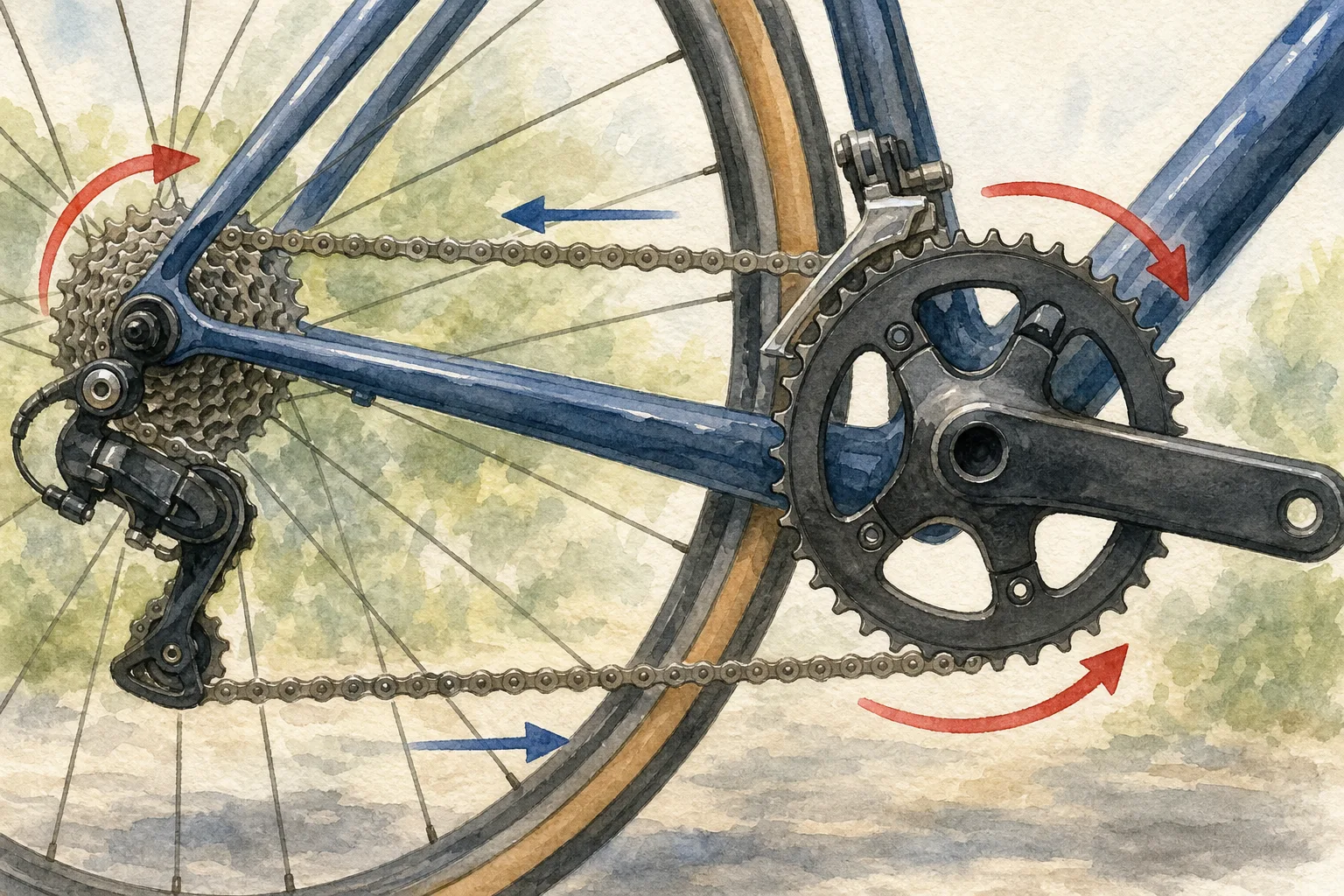
Bicycle gear ratios describe how a chainring and rear sprocket relate their turns, but they do not meet as a pair of meshing gears. That distinction matters: viewed from the bicycle’s right-hand side, both sprockets turn clockwise as the chain moves forwards along the top run.
Chain Drive Basics
A bicycle chain engages the teeth of the front chainring and rear sprocket, carrying motion between them. The sprockets are separated, unlike two external gears whose teeth push directly against each other.
As the chainring turns, each tooth draws a matching length of chain around the drivetrain. The rear sprocket’s teeth engage that moving chain in turn. A chain drive resembles a belt running over two pulleys, though its links and sprocket teeth provide a positive engagement rather than relying on friction alone.
Direction From One View
Direction is easiest to discuss from a named viewpoint. Stand on the bicycle’s right-hand side and look towards its left; as the bicycle moves forwards, the top run of chain travels from the chainring towards the rear sprocket. Both sprockets rotate clockwise from that viewpoint.
Turn the cranks backwards and the chain travels the other way, so both sprockets rotate anticlockwise from the same viewpoint. With two external gears touching directly, by contrast, one clockwise gear drives the other anticlockwise. The difference comes from the connection: a chain wraps around both sprockets, while directly meshing gears meet at their outer edges.
Counting Teeth
Tooth counts describe the relative rotation of chain-driven sprockets. For each complete turn of the chainring, the chain advances by a length corresponding to all its teeth; the rear sprocket turns according to how many teeth it has. A chainring with more teeth than the rear sprocket therefore makes the rear wheel turn more for each crank revolution, assuming the chain remains engaged.
Say an invented drivetrain has a 12-tooth chainring and a 36-tooth rear sprocket. One complete chainring turn draws 12 chain links past the front teeth; those links engage 12 of the rear sprocket’s 36 teeth. The rear sprocket consequently turns one-third of a revolution, in the same direction as the chainring when viewed from the bicycle’s right-hand side.
Swap the counts in that invented arrangement—a 36-tooth chainring and a 12-tooth rear sprocket—and one chainring turn advances the rear sprocket through three revolutions. The ratio compares turns, not the sprockets’ physical width or the chain’s total length.
Speed and Turning Effort
A smaller chainring paired with a larger rear sprocket gives fewer rear-wheel turns for each crank revolution. This is commonly chosen when a rider wants the cranks to turn more easily against a demanding load, though the bicycle’s condition, terrain and rider all affect how a gear feels.
A larger chainring paired with a smaller rear sprocket gives more rear-wheel turns for each crank revolution. It can suit a rider seeking more distance from each crank turn on suitable ground, but it also asks for more effort at the pedals. The gear choice trades crank effort against wheel rotation; it does not create extra power.
Reading Bicycle Gear Ratios
For a useful comparison, identify the chainring and rear sprocket, count their teeth, and keep the viewing direction fixed. Then interpret the connection before applying a direction rule: chain-driven sprockets turn together in direction, while a single external gear mesh reverses direction.
- Check which sprocket the crank turns; if the input is the chainring, compare its teeth with the rear sprocket, but if you are tracing motion from the rear wheel, reverse the input and output roles.
- Count the chainring teeth; if it has more teeth than the rear sprocket, expect more rear-sprocket turns per crank turn, but if it has fewer, expect fewer rear-sprocket turns.
- Count the rear sprocket teeth; if it has more teeth than the chainring, expect fewer rear-sprocket turns per crank turn, but if it has fewer, expect more.
- Choose a viewpoint, such as the bicycle’s right-hand side; if both sprockets rotate clockwise from there, record the chain’s direction as consistent, but if one appears anticlockwise, recheck the viewpoint or trace.
- Check whether a chain links the sprockets; if it does, use the chain-drive direction rule, but if the teeth meet directly, use the rule for meshing gears instead.
- Inspect whether the chain sits properly on the teeth; if it appears displaced or damaged, do not rely on a smooth rotation comparison, but if it is seated and engaged, use the tooth counts to compare turns.
Questions About Ratios?
Do bicycle sprockets turn in the same direction?
Yes, when linked by a chain, they rotate in the same direction. From the bicycle’s right-hand side, both turn clockwise as the chain moves forwards along its top run.
How do I compare a chainring and rear sprocket?
Count the teeth on each and compare the numbers. More teeth on the rear sprocket means fewer rear-sprocket turns for each chainring turn; fewer means more.
Why does a larger rear sprocket feel easier to pedal?
For a given chainring, a larger rear sprocket reduces the rear wheel’s turns for each crank turn. That lower gearing can make turning the cranks against a load feel easier, although the result depends on the bicycle and conditions.
Are bicycle sprockets meshing gears?
No. A chain links the front chainring and rear sprocket, and their teeth engage the chain rather than each other. Directly meshing gears touch one another and turn in opposite directions when both are external gears.
A Worked Comparison
Imagine an invented bicycle-style mechanism with a 12-tooth chainring and a 36-tooth rear sprocket. Treat those counts as the starting inputs: turn the chainring once clockwise from the right-hand side, and the chain carries 12 links past the front teeth. At the rear, those links engage 12 of the 36 teeth, so the sprocket turns one-third of a revolution clockwise. The resulting comparison is one chainring revolution to one-third of a rear-sprocket revolution; if the aim is more rear-wheel turns per crank turn, this pairing is the wrong direction to choose, while a smaller rear sprocket would increase those turns.
When reading bicycle gear ratios, keep the tooth-count comparison separate from the direction question. Counts tell you how many turns relate to one another; the chain connection and a clearly stated viewpoint tell you which way those parts rotate.
Related mechanisms
The Doorstop as a Wedge: Why a Small Taper Holds a Door
Doorstop wedge mechanics show how taper, contact and fit affect a door’s movement, helping you identify…

A Bottle Opener and the Leverage Behind Its Handle
Bottle opener leverage explains how the hook, bottle rim and handle work together, helping you understand…