Why a Zipper Needs Two Rows of Teeth
Why a zipper needs two rows of teeth: see how opposing elements and the slider form a closure, and what alignment has to do with the result.
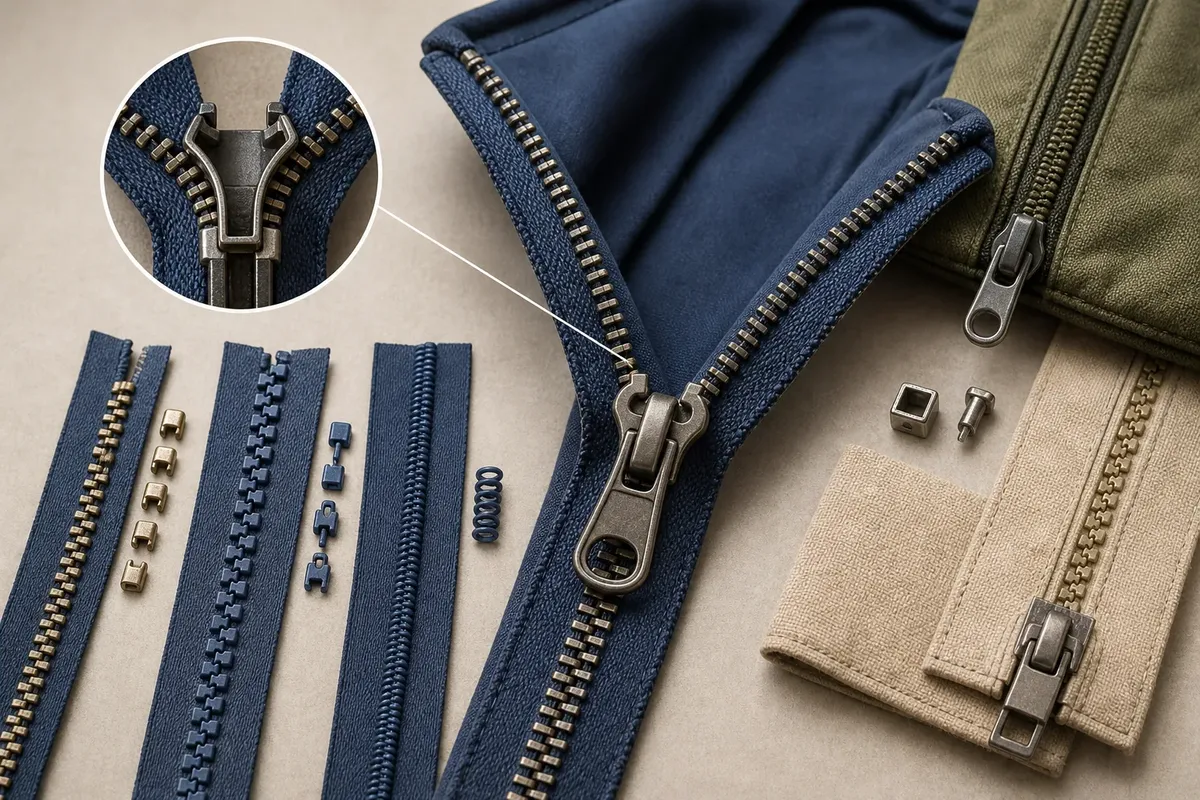
Why a zipper needs two rows of teeth becomes clear when you close a jacket: the slider brings two separate edges together behind itself and leaves them apart ahead. The rows provide opposing elements for the connection; the slider guides them along a path.
Each side carries a row of elements, commonly called teeth. Pulling the tab moves the slider, whose internal channels guide both rows. Exactly how the elements engage depends on the zipper design: molded and metal teeth have distinct shapes, while a coil zipper uses a continuous spiral. The general principle is that the slider guides the two sides into the relationship that lets them close or separate.
What do the two rows contribute?
A zipper needs two rows because each supplies one side of a repeating connection. In many designs, elements on one side engage with spaces or corresponding parts on the other. The specific contact varies by construction, but a single row has no opposing side to connect to.
The elements attach to fabric tape, which is sewn to a garment, bag, or other object. The tape keeps each row in position and spreads the pull along the opening. The tape holds the elements, the elements form the connection, and the slider controls where the rows meet or part.
Element shapes vary. Metal zippers use formed metal pieces; molded plastic zippers have shaped elements along the tape edge; coil zippers use a continuous spiral of nylon or polyester. Their engagement geometry differs, but all have two opposing sides guided through a slider.
How does the slider guide the rows?
Viewed from above, many sliders have a channel that resembles a Y. The wider end allows the two sides to enter separately; the channel then guides them along a narrowing path. Depending on the element design, the rows engage within or as they pass through the slider. The Y shape describes a common arrangement, not every slider’s precise internal geometry.
The slider does not place every element by hand. Its channel guides the rows, while the elements’ shape and arrangement determine how they meet. Pulling the tab moves this guiding junction along the zipper, extending the connected section.
On a separating zipper, a box and pin at the bottom help position the two sides before closing. If either side misses its intended path into the slider, the elements may not engage cleanly. Pulling harder does not necessarily correct that alignment.
Why does moving the slider separate the rows?
Moving the slider in the opposite direction guides the joined section apart. The channel directs the rows toward separate outlets, and their elements disengage as they pass. The exact route depends on the slider and element design, but the slider remains the moving junction between connected and separate sections.
Say you have a pencil case with a zipper that closes as the slider moves right. The rows meet through the slider, leaving a connected section behind it. Move the slider left, and the channel guides them apart; the visible opening follows the slider’s path rather than a separate latch hidden along the track.
What does a zipper bend change?
The rows need to enter the slider in a workable alignment. A tight bend can tilt the tape, shift one row relative to the other, or pull the elements sideways as they enter. That makes it harder for the slider to guide them smoothly.
A zipper that moves easily on a straight section but catches around a pouch corner may be responding to the tape’s path, not a defective tooth. Pulling harder often adds strain without correcting the angle. Easing the fabric so the tape lies flatter may help; if an element is damaged or the tape has come loose, repair may be needed.
Some zipper constructions follow curves more readily than others, but even a flexible coil can catch if the tape folds sharply. The route of the opening matters alongside the shape of each element.
Which parts affect how a zipper works?
- Element design: Observe whether the zipper has distinct metal or molded elements, or a coil. If elements are visibly damaged, stop pulling and consider repair; if they look intact, check alignment and the tape’s path instead.
- Tape: Check whether the fabric edge lies flat and remains attached. If it folds or pulls loose, ease the fabric or seek repair; if it lies flat, look for an obstruction or misaligned elements.
- Slider: Check whether the slider follows the rows without obvious distortion. If it is visibly bent or lets the rows part again, avoid forcing it and consider replacement or repair; if it appears intact, inspect the starting alignment.
- Stops: Look for end pieces that limit slider travel. If a stop is missing or loose, avoid pulling the slider off the track and have the end repaired; if the stops are secure, check whether the slider is catching elsewhere.
- Starting alignment: On a separating zipper, check whether the pin enters the box fully and the tape edges sit evenly. If they do not, reseat them gently before pulling; if they do, move the slider without forcing it.
- Path of the opening: Notice whether the catch occurs at a sharp bend or along a straight section. If it happens at a bend, flatten the fabric path and try a gentle movement; if it persists on a straight section, inspect the elements and slider for damage.
Not every zipper has the same end arrangement. A jacket may use a separating zipper that comes apart at the bottom, while a pocket zipper usually remains joined there. Those configurations affect where the slider travels, not the basic need for two opposing rows.
What do common zipper questions mean?
Why does a zipper close behind the slider?
The slider guides the two sides into engagement as they pass through its channel. The connected section is left behind the moving junction.
Why can zipper rows separate after closing?
The elements may not be engaging or staying engaged. A distorted slider, damaged elements, or tape that pulls unevenly can disrupt their alignment.
How does a coil zipper differ from a tooth zipper?
A coil zipper uses a continuous spiral along each side rather than distinct molded or metal pieces. The two spirals still pass through a slider that guides their engagement and separation.
Does the slider pull each tooth into place?
It guides the rows, but it does not necessarily position each element in the same way across all zipper designs. The elements’ shape and the slider’s channel work together to form the closure.
When is the zipper’s shape worth noticing?
If a zipper catches, notice where it happens: at the start, along a bend, or near an element that looks damaged. The location can suggest whether alignment, tape routing, or an element is involved. Avoid forcing the slider; that can strain the seam or damage an element.
Memorizing every technical name for zipper parts is not worth the effort if the practical question is why the opening works. The useful distinction is between the rows that connect, the tape that holds them, and the slider that guides them.
Why a zipper needs two rows of teeth comes down to opposing sides whose elements are guided into engagement by a moving slider. If it catches, check the rows’ alignment and the tape’s path before applying more force.
More to consider

Borrowed Words, Changed Sounds
Borrowed words can keep their original spelling while pronunciation shifts. Learn how to compare written forms,…

The Place Card and the Shared Table
A place card can ease arrivals and help guests settle. Learn when to assign seats, when…