The Route from Empty Jar to Reuse
Reuse a glass jar for non-food storage by checking its condition, opening and location, then choosing contents you can identify and retrieve without fuss.
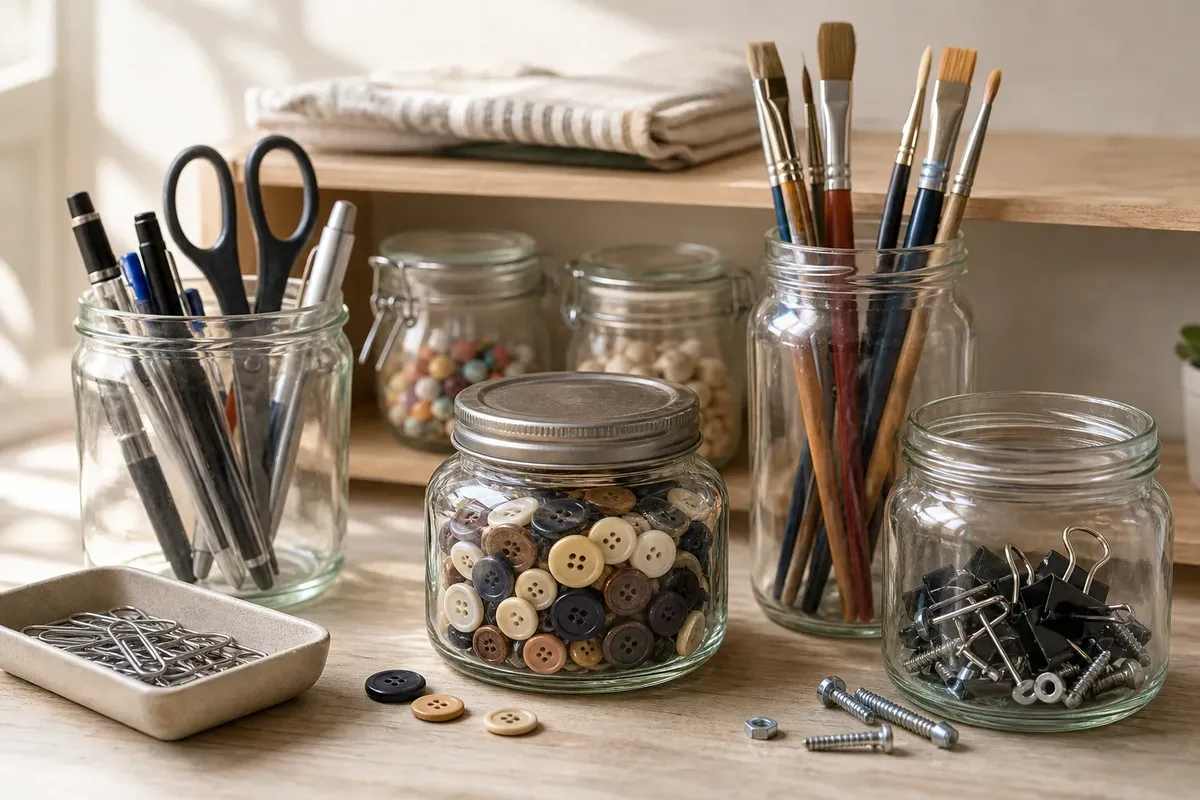
Which glass jar reuse makes sense for the objects you need to store? Start with the jar’s condition, opening and intended location, then match those details to a specific non-food task. An attractive jar that is awkward to use is still awkward, only now it has a job title.
Think first of the items that need a home: spare buttons, paper clips, paintbrushes or loose screws. The choice is not simply whether they fit inside. They should also be easy to retrieve, and the jar should sit somewhere without blocking more useful things.
What should you decide before choosing a jar?
Choose the contents before assigning the container. “Small things” is not specific enough: a mixed handful of craft beads calls for different access than a set of pencils. Decide whether the items need a lid, whether you will reach for them often, and whether seeing them through the glass is helpful.
Keep the proposed use non-food. A jar’s previous role does not establish that it is suitable for later food storage. For non-food objects, focus on sound glass, a clean surface, a workable opening and a stable place to keep it.
It is also worth asking whether a jar is the right kind of container at all. A shallow tray makes sorting easier; a flexible pouch may travel better. Glass is less appealing for items that are easily damaged by hard contact or need to be carried around.
Which physical details change the decision?
Inspect the jar as a tool. Its mouth controls access, its sides affect visibility and labeling, and its base determines whether it will sit steadily where you plan to use it.
- Rim and body: Check for chips, cracks and sharp edges. If the glass is damaged, then do not use it for storage that involves handling; set it aside and follow local guidance for disposal.
- Opening: Compare the mouth with the largest item and with your fingers. If items pass through but are hard to retrieve, then choose a wider jar or a shallow container.
- Shape: Check whether the sides are straight, tapered or curved. If a label needs a flat surface or contents need to remain visible, then prefer a jar with straighter sides; otherwise, use the shape that gives easier access.
- Base: Set the empty jar on its intended shelf, desk or drawer surface. If it wobbles or takes up space needed for access, then choose a stable location or another container.
- Lid: Fit the original lid and turn it as you normally would. If it is missing, corroded, warped or difficult to turn, then use the jar open only when the contents can remain exposed; otherwise, select another container.
- Residue or odour: Inspect under the rim and smell the clean, dry jar. If residue or odour remains after ordinary cleaning, then do not assign it to the proposed storage task; choose a cleaner jar or another container.
- Location: Put the jar where it would live and check whether nearby items remain reachable. If it blocks access or is easy to knock over, then move it or use a different storage option.
Follow relevant product instructions for cleaning agents, labels and adhesives. Do not spend an afternoon trying to rehabilitate a jar whose damage rules it out. Sorting the glass according to local guidance is a reasonable end to its service.
Does an open jar or a lidded jar fit better?
An open jar gives quick access and makes its contents visible. It suits items you use often and can safely leave exposed, but a tip can scatter them and dust can settle inside.
A lidded jar keeps loose pieces together in a cupboard or drawer. Use one only if the lid fits properly and you can open it without a struggle. The contents should also leave enough room for the lid to close without pressing against them.
Do not keep a lid just because it came with the jar. If the objects can stay open and the location is stable, an open jar may be simpler. If containment is necessary and the lid is absent or faulty, pick another jar or a container designed for the task rather than improvising a closure.
Which storage arrangement suits different objects?
Consider the action you perform most: reaching, sorting or keeping objects upright. That points to a more useful arrangement than choosing by appearance alone.
When does open-access storage work?
It works for frequently used objects such as paper clips or pens when the mouth is broad enough for easy retrieval. Put the jar on a stable desk or shelf, not at the edge of a crowded surface.
When is a lid useful?
A lid helps contain small loose items such as buttons or craft beads in a cupboard. The opening still needs to let you remove what you want without tipping the whole contents into your hand.
When is an upright holder a poor fit?
A jar can hold brushes or pens upright if it is stable and the objects sit without crowding. Avoid this arrangement when delicate tips strike the glass or the tall container is likely to be bumped in its location.
What questions help settle a glass jar reuse?
Can a narrow-neck jar still be useful?
Yes, if the objects pass through the opening and do not need to be chosen one by one. For mixed items that need sorting, choose a wider opening or a tray.
Does a missing lid rule out the jar?
No, provided the contents can remain open and the jar will sit somewhere stable. If the items need to stay contained, use a jar with a sound lid or a different container.
What should you do with a chipped rim?
Do not use a chipped jar for storage that requires repeated hand access. Set it aside and follow local guidance for handling or disposal; do not try to make the edge usable.
Is decorating the jar useful?
It may help identify contents in a cupboard, but decoration is not necessary if the contents are already easy to see. Paint or glued trim can also make the jar harder to inspect and clean.
How can you make the choice with the jar and contents in front of you?
Imagine you have one clean, sound, squat jar with a smooth lid, a handful of spare buttons and a shallow cupboard shelf. Put the buttons beside the jar, then pass them through the mouth and remove one without shaking the container. If that is comfortable, place the closed jar on the shelf and check that the cupboard still opens freely. The observable result is that the buttons remain together and can be retrieved individually; if the opening makes selection awkward, use a shallow box instead. If the lid does not turn smoothly, leave the jar open only if the shelf is stable and the buttons can safely remain exposed; otherwise choose a different container.
This comparison uses actual starting items and a location, rather than a guess based on the jar’s appearance. The decision changes with the task: a jar that works for buttons may be a poor holder for brushes, and a container that fits its contents may still obstruct the shelf.
When is reuse more effort than it is worth?
Do not make a project out of a poor candidate. Trying to remove an odour that survives ordinary cleaning, finding a replacement lid or decorating a jar to imitate a basic tray may take more effort than the result deserves. A damaged jar, an unsuitable opening or a jar with nowhere sensible to live does not need a second career.
Nor is every object improved by contact with glass. If the contents need frequent sorting, must stay firmly contained, or could be damaged by hard surfaces, choose a tray, box or other suitable container. Reuse works best when the jar already fits the task.
For a useful glass jar reuse, check the glass, try the opening with the intended objects, test the lid if needed and place the jar in its actual storage spot. If any of those checks points to an awkward or unsafe arrangement, change the container rather than making the jar’s new role more complicated than the old one.
More to consider
Why a Zipper Needs Two Rows of Teeth
Why a zipper needs two rows of teeth: see how opposing elements and the slider form…

Borrowed Words, Changed Sounds
Borrowed words can keep their original spelling while pronunciation shifts. Learn how to compare written forms,…